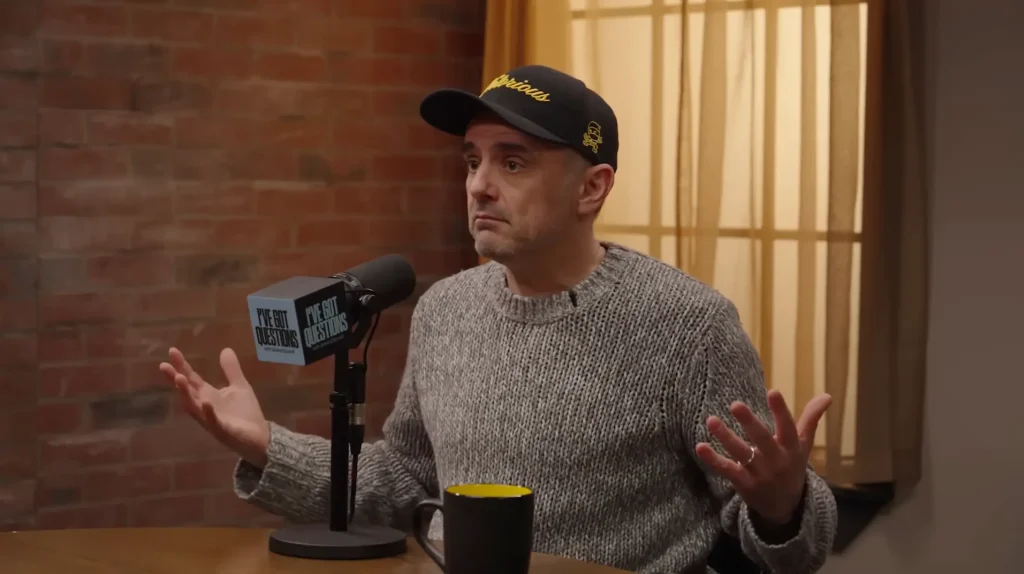
For almost two decades, social media has felt like gravity: a constant, invisible force shaping our days. We wake up, pick up the slab of glass, and start scrolling. What this conversation between Sinead Bovell and Gary Vaynerchuk makes clear is that this “constant” is about to become a historical phase. The next chapter is not another app. It is a change in distribution itself: from phones and feeds to glasses, augmented reality, and fully immersive environments.
When distribution changes, everything changes. That is Gary’s core claim. He has lived through multiple distribution shifts already. He took his family wine business online in the late nineties. He built one of the first YouTube-native shows before “creator economy” was a phrase. He wrote early checks to Facebook and Twitter when they still looked like toys. His career is a long record of betting correctly on where attention is going. So when he says glasses are going to do to the smartphone what the smartphone did to television, it is worth paying attention.
The most provocative idea in this discussion is that we are likely at the beginning of the end of the social media era as we know it, but not because people suddenly stop wanting content. The reason is that the current form factor – a small vertical rectangle filled with 90-second videos – will start to feel as old-fashioned as a silent film. Sinead frames it clearly: if the primary interface shifts to voice and glasses, you cannot keep the TikTok feed and simply strap it to your eyeballs. The format itself has to change.
Gary’s response is that he thinks augmented reality is the huge winner in this next wave. He imagines a world where “video” stops being a flat rectangle and becomes three-dimensional and interactive. You throw on your glasses and you are no longer watching a clip; you are inside a scene. A third guest can be “in” the studio with them without physically being there. A film franchise like Star Wars is not something you sit and watch. It is a spatial, activated environment that surrounds you. He connects this to early signals like the Sphere in Las Vegas and large-scale immersive venues, which already hint at the appetite for enveloping audiovisual experiences.
What makes this more than idle futurism is Gary’s sense of timing and pattern. He reminds Sinead that new technologies always start clumsy before they transform everything. The first television commercials were essentially radio scripts read over a static image. Early iPhone apps were beer-drinking simulations. In the same way, he predicts that the first wave of AR “content” will probably be one-minute videos clumsily ported into glasses. It will look and feel wrong. Then, about a decade after the hardware is viable and widely adopted, creators and brands will finally understand the native language of that medium and build for it. That is when the real behavioral shift happens.
A second thread running through the conversation is the role of voice in all of this. Sinead argues that as AI systems get more reliable and more voice-first, we will break the habit loop of pulling out our phones to open, swipe, and scroll. We will simply speak commands. Gary is emphatically bullish on this. He recalls how early exposure to Alexa made him realize he was looking at the worst voice technology would ever be, and even then it was already useful. He now only prompts in voice. He points out that there are entire startups operating voice-first, where people talk to their tools instead of typing. For him, voice interfaces are not speculative. They are already here, just waiting for better models and better hardware.
Where Gary diverges slightly is in emphasis. He sees voice and AR not as either-or, but as an “and.” Voice is how we instruct and query. AR is how we perceive and feel. He thinks glasses will be the main event, with voice layered into that environment as a natural way to command agents, set preferences, and orchestrate our surroundings. Sinead’s phrase “AI in your ear” via AirPods and live translation features becomes a precursor to “AI in your world” through spatial overlays.
The third major axis is social proof at the behavioral level: what people are already doing. Sinead brings in emerging data that Gen Alpha is spending less time on traditional feeds, getting phones later, and often living more in DMs and private spaces than in public content streams. Gary, as a parent of teens and as an operator who studies youth culture, confirms he is seeing similar signals. He describes a barbell future: on one end, extreme immersion in technology, and on the other end, a growing desire to go offline, meet people in person, return to tangible experiences, and even resurrect “dead” media and devices for irony and nostalgia.
Rather than seeing offline behavior as a rejection of technology, Gary frames technology as the “gateway drug to in real life.” Dating is his favorite example. In cities like New York, the majority of dates on a Thursday night now start in a phone – through DMs, dating apps, or even platforms like Substack and LinkedIn. Social technology produces the introduction. The value, however, is realized in real-world encounters. He expects brands to lean into this more and more: using digital tools and data to orchestrate gatherings, running clubs, hiking meet-ups, immersive installations, and live events that are actually worth showing up for.
All of this loops back to immersive tech in a subtle but important way. The future is not a binary between “screen time” and “real life.” It is a spectrum of mediated experiences, from soft augmentation (a heads-up layer over your physical world) to full immersion (stepping into an entirely synthetic environment) to fully analog offline moments. The real competitive arena is attention, not device category. In that sense, AI agents, AR glasses, live immersive venues, and offline experiences are all part of the same battle for where we choose to be present.
Another layer of social proof is Gary’s own history with formats. He is about to celebrate the twentieth anniversary of his first YouTube video. There was no lighting, no audio, no polish. He shot that way for five years while others rushed to production value. It still worked, because his knowledge and enthusiasm for wine were real, and because his intent was to help a generation learn about wine without pretension. That lived experience grounds his prediction that authenticity, not medium, will continue to be the durable asset. He is comfortable imagining an “AI movie” he could make today that would still feel authentic, because to him authenticity comes from intent and action, not from whether a camera, canvas, or model was involved.
This matters for XR and immersive tech because it answers a common anxiety: will synthetic environments and AI-generated worlds kill “real” human expression? Gary’s historical examples cut against that fear. Artists once claimed that painting on canvas was inauthentic compared to painting on buildings. Radio and television were once “machines” that supposedly cheapened messages. Written words were once suspect compared to spoken ones. Each time, what survived and scaled was not the purity of the medium but the depth of the intent. If we carry that logic forward, immersive experiences built with AI and XR will be judged less on whether they are virtual and more on whether they move people.
From a strategic perspective, Gary’s advice to creators and brands is disarmingly simple. First, squeeze everything you can out of the current discovery engines while they still work. He urges creators to “extract the living” out of TikTok’s discoverability and to avoid being trapped on a single platform. His own track record includes building large audiences across YouTube, Facebook, Instagram, LinkedIn, Snapchat, and more. That cross-platform muscle is a form of social proof too. It shows that what ultimately ported across formats was not the algorithm, but his value proposition: a mix of practical business advice, optimism, and cultural pattern recognition.
Second, he argues that you must decouple your value proposition from the medium of the moment. You should be able to answer the question: what do you offer that is independent of whether the interface is a feed, a live stream, a spatial AR experience, or a voice-only agent? If your “edge” is only that you know how to farm TikTok trends or optimize a Facebook ad account, you are building on sand. If your core value is, for example, making complex technology feel human, or designing unforgettable in-person experiences, or telling emotionally resonant stories, you can translate that into whatever immersive form comes next.
Third, he endorses a dual-plane mindset. One plane is the present, where you continue to operate in today’s social ecosystem as long as it yields attention and opportunity. The other plane is the future, where you “get on the treadmill” with emerging tools: experimenting with agents, playing with AR filters and prototypes, testing live shopping, trying voice-first workflows, and learning enough to recognize new paradigms when they appear. He does not advocate becoming a technical savant. He advocates becoming fluent enough that, when the new distribution shows up, you can say, “That’s it,” and move early.
Perhaps the most revealing part of the conversation, though, is not any single prediction, but Gary’s posture toward the future. He is explicit that he has often been early on timing. He thought everyone would be buying everything online by the year 2000. He has the gray hairs to remind him that diffusion takes longer than it looks from the bleeding edge. That tempering does not make him less bullish. It makes him more patient. When he talks about AI, voice, and AR, he does so with the calm of someone who has already seen multiple “end of the world” moments dissolve into new normals.
For XR, VR, and immersive technologies, that is the hidden lesson. The next wave will not feel like a clean break. It will feel like a muddled, slightly awkward overlap of old and new. TikTok-style feeds will be hacked into glasses. Voice assistants will mishear us in ridiculous ways. Live sports will experiment with spatial overlays that sometimes feel like clutter. Most of it will look, in retrospect, like the equivalent of early TV spots reading radio copy over static images. But buried in that noise will be the first native expressions of the new medium, probably coming from people and places no incumbent is watching.
If Gary is right, the phone-centric social media era is already hairline-cracked. AI is eroding the psychology of posting to prove something to other humans. Voice is quietly training us to interact with machines without screens. AR hardware is creeping from novelty to inevitability. Gen Alpha is signaling a desire for different relationships with devices and with each other. And in basements, garages, and small studios around the world, people are already using these tools to prototype forms of entertainment and experience that will make today’s doomscroll feel quaint.
The question is not whether immersive technologies will come to dominate. The question is who will be ready when glasses replace the feed as the default window on the world, and how many of today’s creators, brands, and institutions will successfully make the jump.